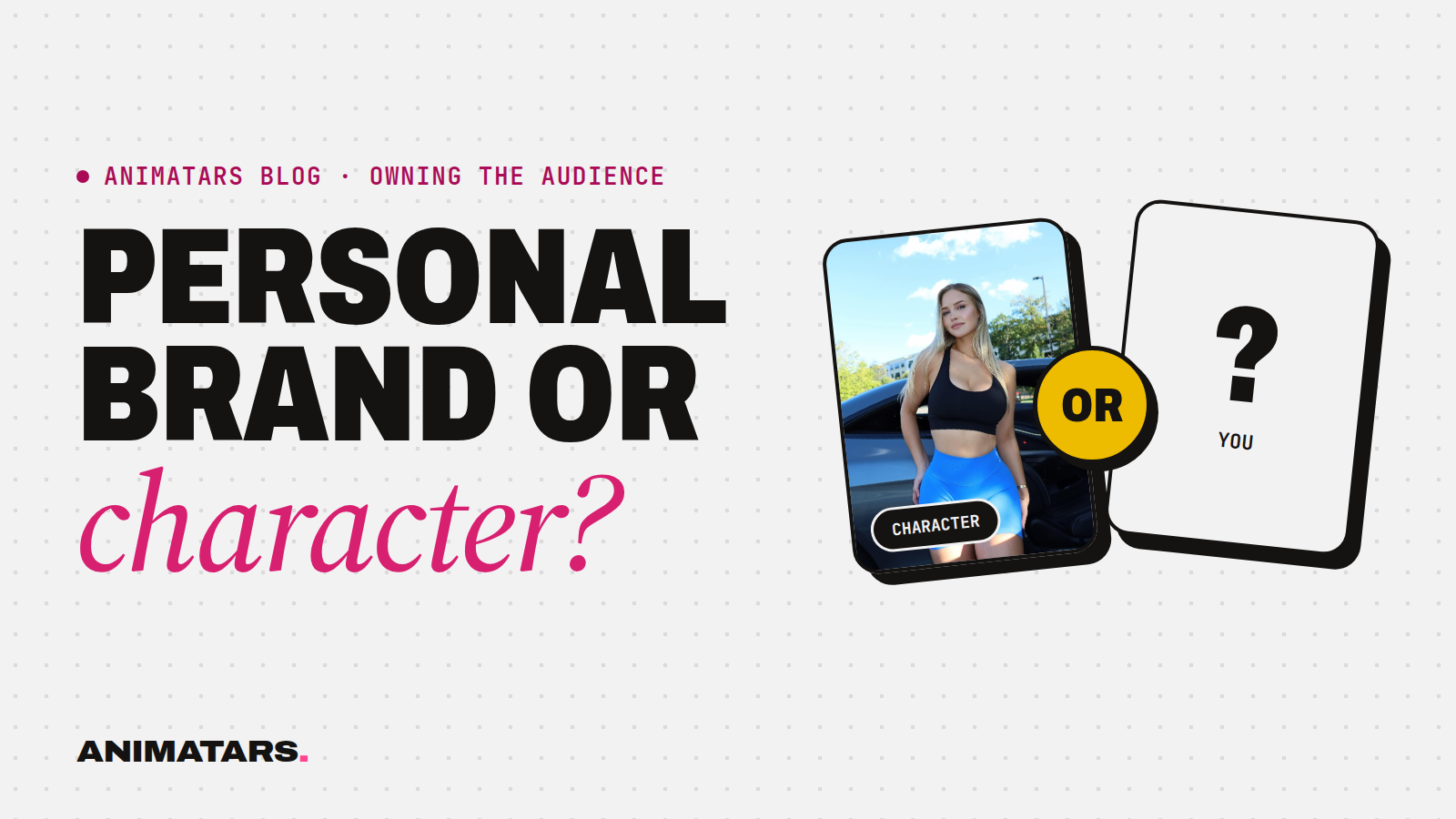
Picture two people starting a home decor account on the same Monday.
The first one, let’s call her Dana, films her own living room. Her face, her cat, her slightly wonky curtain rail. The second one, let’s call him Sam, designs a character: a calm, plant-obsessed renter with a soft voice and a signature linen shirt. Sam never shows up on camera at all.
Both can work. Both can flop. The question of personal brand vs character brand isn’t about which is “better.” It’s about which one fits your life, your privacy and how you like to work. Below you’ll find a side-by-side comparison, the trade-offs nobody mentions, and a ten-question quiz at the end to settle it.
The quick definitions
Personal brand: the audience follows you. Your face, your name, your opinions, your real kitchen. When you have a bad hair day, the brand has a bad hair day.
Character brand: the audience follows a persona you built. It might be an illustrated mascot, a voice-only narrator, or an AI-generated creator with a consistent face. You’re the writer, director and producer, not the star.
At Animatars we build character brands, so yes, we’re biased. We’ll try to be fair anyway. Personal brands have real advantages, and we’ll say where they win.
Personal brand vs character brand, side by side
| Personal brand | Character brand | |
|---|---|---|
| Privacy | Low. Your face and life are the content. | High. You can stay completely behind the scenes. |
| Startup effort | Low. Grab your phone and film. | Higher. You design a character, keep them consistent, set up a workflow. |
| Daily effort | Depends on your energy, lighting, mood. | Depends on your system. A good workflow makes it repeatable. |
| Trust | Built-in “real person” warmth. | Built through usefulness, consistency and clear AI disclosure. |
| Scaling | Hard. There’s one of you. | Easier. You can run several characters for different niches. |
| Selling | Strong for coaching, services and anything personal. | Strong for products, printables, affiliate picks and templates. |
| Risk | Burnout, privacy leaks, your life becoming content. | Looking fake, inconsistency, forgetting to disclose. |
| Exit options | Hard to hand off. The brand is you. | Easier to hand off or sell. The brand lives in documents and files. |
Where a personal brand wins
Let’s give Dana her due.
It’s fast to start. No prompts, no character bible, no figuring out why the AI gave your character six fingers. You hit record.
Real-life proof is hard to beat. When Dana shows her actual rental before and after, people know it happened. That’s powerful for things like coaching, consulting or teaching a craft hands-on.
Live stuff is easy. Livestreams, workshops, meetups. You’re a person, so you can just show up.
If you love being on camera and don’t mind people knowing where you buy your throw pillows, a personal brand might be your thing.
Where a character brand wins
Now Sam’s turn.
Privacy. This is the big one. Plenty of talented people would never post their face online: parents, people with day jobs, people who just don’t want to be recognized at the grocery store. A character lets them create anyway. Our creator Claudia (DIY with Claudia) reached 582K+ followers and 100M+ views across platforms in 90 days with zero real faces shown. That’s one creator’s result, not a promise, but it shows the format can connect.
Consistency on bad days. Your character doesn’t get sick or tired. You do, but a good system means the content can still go out.
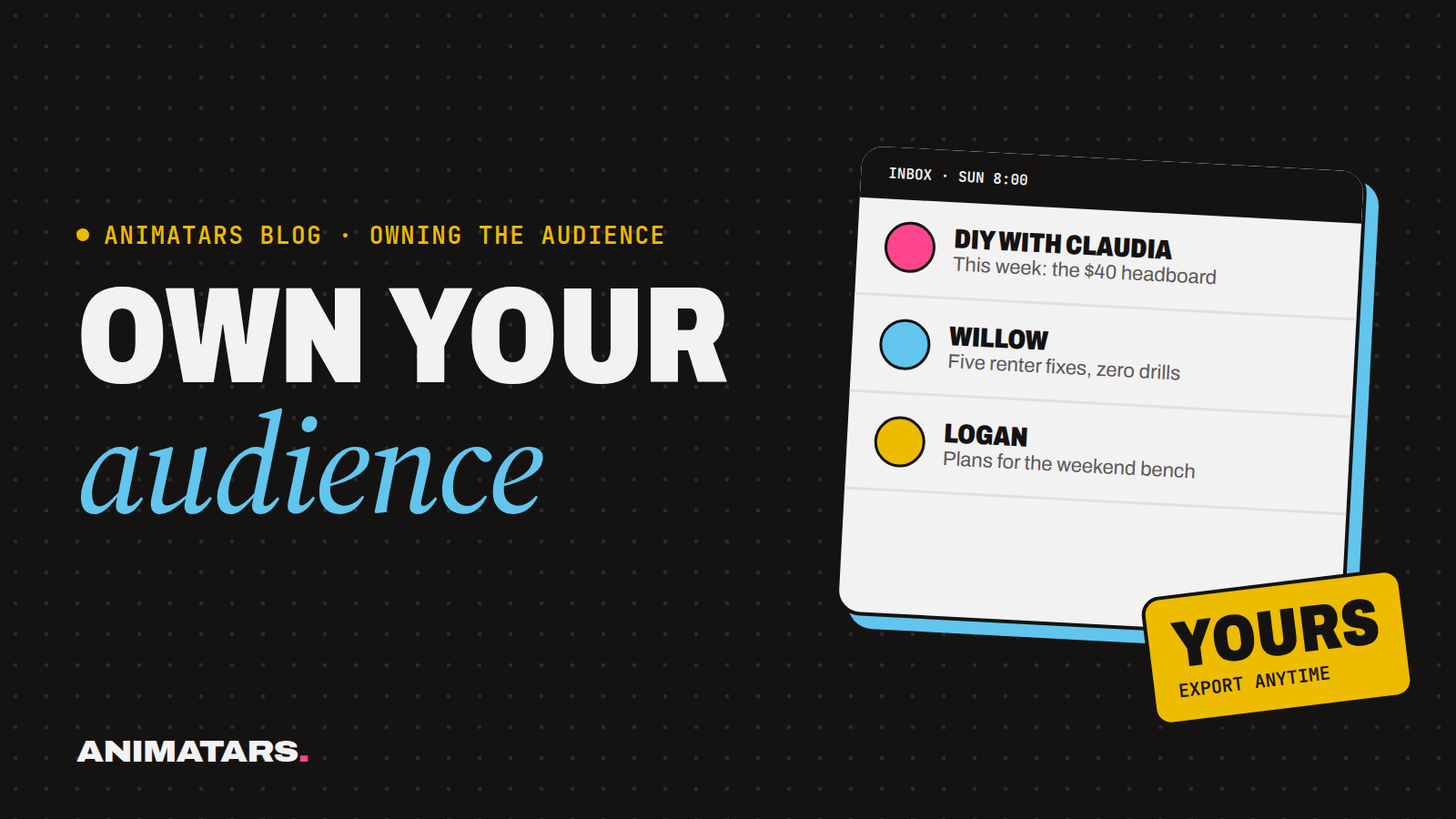
Multiple niches. One person can run a cozy-budget character like Alice and a build-focused one like Logan without mixing the audiences. Try doing that with your own face.
It’s an asset. A character with a written bible, a prompt library and a website is something you own and can hand off. A personal brand mostly lives in your head.
If you’re leaning this way, our guide to becoming a faceless content creator is the practical next step.
The trade-offs nobody mentions
Character brands take setup
You’ll need a character bible: a document that pins down their face, style, voice, backstory and rules. Without one, your character drifts, and audiences notice fast. It’s a few evenings of work, but it saves you months of “why does she look different this week?”
Disclosure isn’t optional
If your character is AI-generated, say so. In the bio, in posts where the platform offers an AI label, and on your website. Platforms have their own settings for labeling AI content, and they change, so check the current options. Honesty is also just good business: the people who stick around after reading “AI-generated” are the ones who are there for the content.
Personal brands are harder to protect
When the brand is you, every post is a small piece of your life. Some creators love that. Others discover, a year in, that they’ve shared more than they meant to.
Both still need a home
Whichever you choose, the platform owns the follower list. Build an email list and a website so your audience can follow you anywhere. We make that case in Why Every Creator Needs a Website.
The hybrid option
You don’t have to pick a pure version. A few blends we’ve seen work:
- Character in front, you behind. The character hosts the content, and your newsletter has a short “from the team” note in your own words.
- You in voice, character in visuals. You narrate, the character appears on screen, and you’re clear about which parts are AI.
- Personal brand plus a mascot. You’re the face of the coaching business, and a character runs the playful short-video account that feeds it.
The rule for all of them: never blur who or what is real. If a viewer would feel tricked finding out later, fix it now.
The quiz: which brand should you build?
Grab a pen. For each statement, give yourself a point in column A or column B.
- Being recognized in public sounds: A fine, even fun. B like a nightmare.
- You’d rather spend an evening: A filming yourself. B writing, designing and editing.
- Your main offer will probably be: A coaching, services or live teaching. B products, printables or affiliate picks.
- Your energy for being on camera is: A steady. B unpredictable.
- You’d like to run more than one niche someday: A no. B yes.
- Your day job or family situation makes posting your face: A no problem. B complicated.
- Your favorite part of creating is: A sharing your life. B building a world.
- You’d like to be able to hand the brand to someone else one day: A not really. B maybe.
- Setting up a system before you post feels: A like a chore. B kind of fun.
- Explaining “this character is AI-generated” in your bio feels: A awkward. B totally fine.
Mostly A: a personal brand will likely feel more natural. Start filming.
Mostly B: a character brand is probably your fit. Start with a character bible, then your first week of posts.
Pretty even: try the hybrid. A character in front and your own voice in the newsletter is a lovely middle ground.
FAQ
What is the difference between a personal brand and a character brand?
A personal brand is built around you: your face, name and life. A character brand is built around a persona you create, like a disclosed AI creator, with its own look, voice and backstory.
Is a character brand less trustworthy than a personal brand?
Not if you’re honest. Trust comes from being useful and consistent, and from clearly disclosing that the character is AI-generated. For more on the trust side, see What Is an AI Influencer?.
Can I switch from a character brand to a personal brand later?
Yes. Plenty of creators start with a character for privacy and later add their own voice behind the scenes. Owning your email list and website makes any switch much easier.
Can one person run more than one character brand?
Yes, and it’s one of the real perks. Keep each character’s look, voice and audience separate, and label each one clearly as AI.
So, Dana or Sam?
Either can build something real. The best choice is the one you’ll still enjoy in six months, on a Tuesday, when nobody’s watching the numbers.
If your quiz landed on B, we’d love to help you build your character, from the bible to the website. Join the beta.